Pakistan’s solar landscape is undergoing a major policy shift that has raised
concerns among rooftop solar users. With rising tariffs and load shedding, solar
power has become a priority across the country. However, the recent
replacement of net metering with net billing has created confusion, making it
essential for solar consumers to understand how this change affects their
investment.
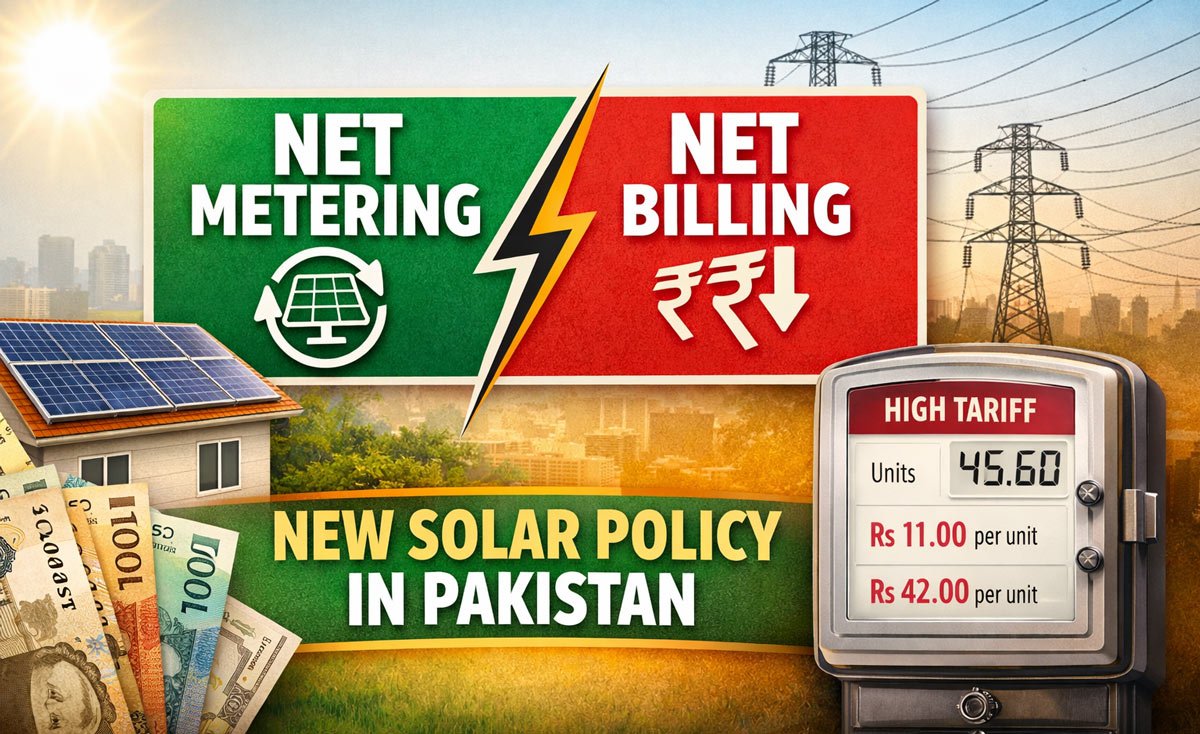
NEPRA has replaced the net metering system with a net billing system.
According to the previous net metering system, solar consumers can balance the
electricity they produce with what they consume. If they export extra units to the
grid, those units are deducted from their bill, resulting in a minimum or zero
electricity bill. In the NEPRA net billing policy, on the other hand, solar users will
sell their extra units to the grid at lower rates and will buy electricity with regular
higher tariffs. The selling price of units to grid is approximately Rs.11 and will be
bought at Rs. 40 to 50 or more.
It is also important that existing net metering consumers will eventually be shifted
to the net billing system under the revised policy. This transition further
emphasizes the need for both existing and new solar users to understand system
design. In Pakistan, by using more solar power during daylight hours and
incorporating battery storage through hybrid systems, consumers cansignificantly reduce their reliance on grid electric power, purchased at high tariffs.
While net billing reduces the incentive of exporting electricity, solar power
continues to offer long term savings and protection against future tariff hikes if it
is used intelligently.
In conclusion, the shift from net metering to net billing has changed the financial
dynamics of rooftop solar but it has not removed the relevance of solar energy.
By focusing on consumption, adopting hybrid systems and reducing reliance on
grid, solar consumers can still achieve long term energy benefits.